The Silver Hand: Why Bespoke Artisanal Silver Has Become the Truest Marker of American Luxury
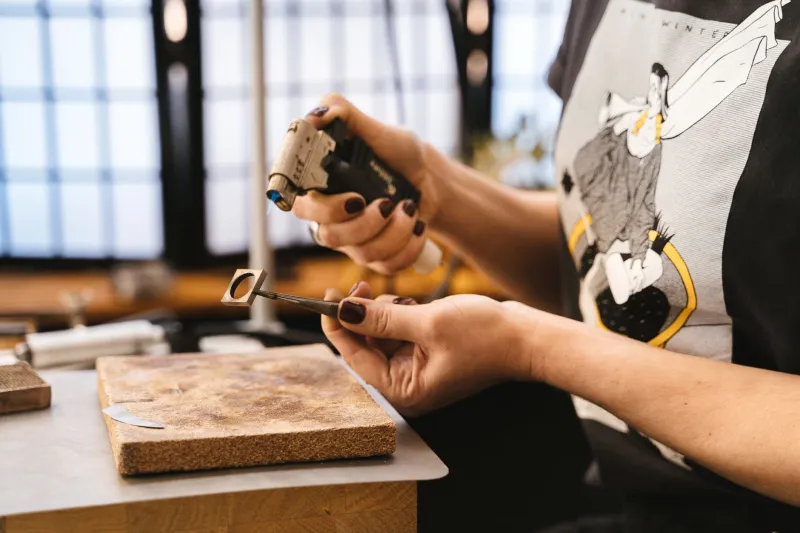
There is a particular kind of satisfaction that arrives only when you hold something made by a single pair of hands. Not assembled. Not cast by the hundreds in an overseas facility and polished to indistinguishability. Made — slowly, deliberately, with the full weight of intention — by a craftsperson who understood, from the first sketch to the final burnish, exactly what the piece was meant to become.
This is the sensation that is quietly reshaping the upper echelons of American jewelry collecting. And silver — long underestimated, perpetually overshadowed by gold and gemstone — is at the center of it.
The Fatigue of the Familiar
For years, status in American luxury jewelry was communicated through recognizable iconography: the interlocking letters, the signature clasp, the house motif repeated across catalogues and wrists and magazine spreads until it became wallpaper. Ownership of these pieces was never truly about the object. It was about legibility — the assurance that anyone in the right room would recognize what you were wearing and understand its price.
That calculus is changing. Among collectors who have spent decades building and refining their sensibilities, legibility has lost its appeal. What they seek now is something far more elusive: singularity.
"When everyone can identify your jewelry at twenty feet, you've bought a uniform, not a piece," observes one New York-based collector who has spent the past decade transitioning her collection almost entirely to bespoke artisanal work. "I became interested in silver when I realized that the people who truly understood it — the craftspeople who had devoted their lives to the metal — were making things I had never seen anywhere else."
Silver as Language
The word rajata — Sanskrit for silver — carries within it a philosophy that the most thoughtful contemporary collectors are only now beginning to fully inhabit. Silver is not a second-place metal. It is, in many of the world's oldest craft traditions, the metal of the moon, of reflection, of considered thought. It rewards patience. It develops character with wear. It does not announce itself; it reveals itself.
Master silversmiths working today in studios from Santa Fe to Brooklyn to the mountains of Colorado speak of the metal with a reverence that is almost liturgical. "Silver has memory," explains one third-generation silversmith whose work is held in private collections across the American Southwest and Northeast. "Every tool mark, every hammer blow — the metal records it. You cannot lie to silver. It shows everything."
This transparency is precisely what draws the new generation of discerning American collectors. In an era when provenance and authenticity have become the true currency of luxury, a piece of handcrafted silver jewelry offers something no mass-produced house piece can replicate: an unbroken chain of evidence connecting the object to its maker.
The Bespoke Commission as Intellectual Exercise
For those who have entered the world of commissioned artisanal silver, the acquisition process itself becomes part of the value. Unlike purchasing from a brand's seasonal collection, a bespoke commission demands conversation — often extended, sometimes philosophical — between collector and craftsperson.
"My clients come to me with ideas, but also with questions," says a silversmith based in Taos, New Mexico, whose waiting list currently extends nearly two years. "They want to understand the alloy, the technique, the finish. They want to know why I'm choosing a particular gauge of wire or a specific patination method. By the time the piece is complete, they understand it in a way that simply cannot happen with a retail purchase."
This education is not incidental. It is, increasingly, the point. The collector who understands her piece — who can speak to its construction, its cultural references, the specific decisions made in its creation — possesses something that no price tag can confer: genuine connoisseurship.
Wearing Intention
The pieces that emerge from this process share a quality that is immediately perceptible to the trained eye, even when it resists easy description. They carry weight — not merely physical, though handcrafted silver is often more substantial than its machine-made counterparts — but conceptual weight. They have been thought about.
This is what separates the new silver collecting from mere trend adoption. The collectors building these wardrobes are not chasing novelty. They are constructing something far more durable: a personal aesthetic language in which every element has been chosen with full awareness of its meaning, its making, and its maker.
"I wear pieces that I could explain to anyone," says the New York collector. "Not their price. Their story. That's a completely different kind of luxury. And frankly, it's a more interesting one."
The American Context
There is something particularly resonant about this movement within the American luxury landscape. The United States has its own deep traditions of artisanal silversmithing — from the extraordinary legacy of Native American metalwork in the Southwest to the colonial silversmiths of New England whose pieces now command serious auction prices — and the contemporary collector who engages with living craftspeople is, in some sense, choosing to participate in that living tradition rather than simply admiring it from a distance.
Several of the country's most respected contemporary silversmiths describe a marked shift in their clientele over the past five years: more collectors arriving with serious intent, longer commissions, deeper questions. The conversation has matured.
"Five years ago, clients wanted a statement piece," one craftsperson notes. "Now they want a piece that makes a statement they actually believe in. That's a meaningful difference."
The Standard That Endures
At House of Rajata, the principle has always been that true luxury is defined not by volume or visibility, but by the quality of attention brought to each acquisition. Handcrafted silver jewelry — bespoke, rooted in artisanal tradition, made by hands that have devoted themselves to a single demanding discipline — represents that principle in its most concentrated form.
The status it confers is not the status of the logo or the price tag. It is the status of the person who knows the difference, who has done the work of developing taste, and who wears the evidence of that work on her wrist, her collar, her hand.
That is a standard that does not depreciate.


